


Ashdon Primary School
_png.webp)
Small school. Big welcome.
Reception places for September 2027!
Open Evening - 11th November @ 18:00 or
book a private tour to suit your schedule!

Performance Data 2025-2026
Ashdon Primary School is a small village school with around 57 pupils taught in three mixed-age classes. Because our year groups are small, a single child can represent a large percentage of a cohort — in 2025–26 our Year 6 cohort was four pupils, so each child accounts for 25% of the published figure.
For this reason, the Department for Education suppresses results for cohorts of this size in the national performance tables, and percentages should be treated with caution when compared with national figures or with our own results in previous years. Small-cohort data tells you very little about the quality of teaching across the school, and a great deal about the particular group of children in that year group.
Where national comparison figures are shown below, the year they relate to is stated.
National Key Stage 2 figures for 2026 are provisional. National figures for the Early Years Foundation Stage Profile and the phonics screening check are published later in the year, so the most recent confirmed figures are used.
Early Years Foundation Stage 2025-2026

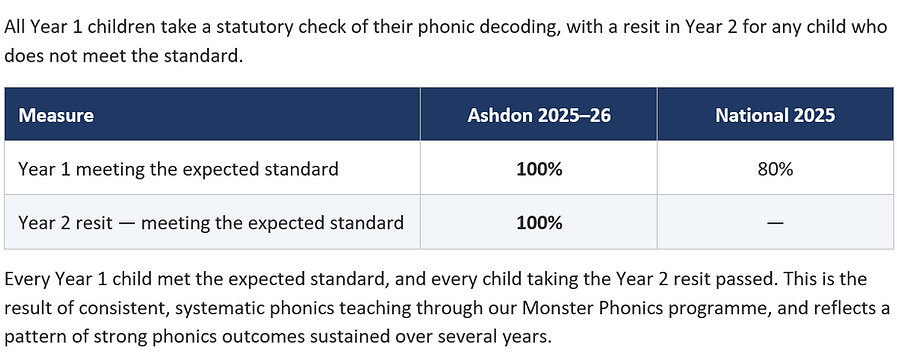
Phonics Screening Check 2025-2026
Multiplication Tables Check 2025-2026

KS2 SATs 2025-2026
Four children completed their Key Stage 2 assessments at Ashdon this year.
Where a cohort is this small, individual children's results can be worked out from a percentage. For this reason the Department for Education does not publish school-level results for cohorts of our size in the national performance tables, and we have taken the same approach here in order to protect our pupils' privacy. We are proud of what this group of children achieved, and equally clear that four sets of results tell you very little about the quality of teaching across a school.
For context, nationally in 2026, 63% of pupils met the expected standard in reading, writing and mathematics combined (reading 75%, writing 73%, mathematics 75%, grammar, punctuation and spelling 74%).
Our full results are reported to and scrutinised by the governing body. If you would like to talk about how your child is progressing, or about the school's performance more generally, please contact the office to arrange a conversation with the Headteacher.
How we use assessment across the school
Statutory tests give a snapshot of a small number of children at two points in their primary education. To understand how every child is doing, we assess more broadly and more often:
-
Standardised assessments in reading (PIRA), mathematics (PUMA) and grammar, punctuation and spelling (GAPS) three times a year, giving us nationally benchmarked scores for every child from Year 1 upwards.
-
Termly pupil progress meetings for every class, at which each child’s progress is discussed individually and next steps agreed.
-
Targeted support where it is needed, including before-school and lunchtime booster sessions for older pupils.
-
Regular reporting to governors, who hold the school to account for the progress of all groups of pupils.
From September 2026 we have adopted the White Rose Maths scheme across the school, chosen for its balance of fluency, reasoning, rapid recall and challenge.